

Ten minutes into a sales call, you feel it. You’re answering questions, showing case studies, explaining your process. Doing everything right.
But something is wrong.
You’re not consulting. You’re auditioning.
You’ve become the candidate. They’ve become the judge.
And the moment that dynamic settles in, you’ve already lost.
Deep clients don’t hire people who audition. They hire people who select.

The problem isn’t your portfolio. It isn’t your experience or your pricing or your pitch.
It’s your posture.
Somewhere along the way, you built a business designed to please.
To accommodate.
To chase.
You answer questions instead of asking them. You justify your value instead of demonstrating it. You wait for permission instead of leading.
And the clients feel it. They sense the need underneath your professionalism. It tells them something about what working with you will be like.
This isn’t a script problem.
It’s a system problem.
Your entire marketing infrastructure was built for volume.
Built to attract anyone who might pay.
Built to convince.
That machinery creates shallow clients. Every time.
Convincing Is Exhausting
When you convince, you’re trying to turn a skeptic into a believer. You’re working against resistance.
You explain why you’re worth it. You handle objections. You follow up. You hope.
Your nervous system stays in a state of asking. Performing. Proving.
This is exhausting not because you’re bad at it. It’s exhausting because the dynamic itself is draining. Every conversation starts from doubt.
And even when it works, what have you created? A client who needed persuading. A client who will likely need convincing again at every stage of the project.
Convincing creates shallow clients. Not because they’re bad people. Because the relationship was built on persuasion, not resonance.

Resonance Is Different
There’s another way. You’ve probably felt it in glimpses.
A client reaches out already understanding what you do. They don’t need convincing. They’re not comparing you to five alternatives. They just want to know how to begin.
Those conversations feel different. Lighter. Like meeting someone who already speaks your language.
That’s resonance.
Resonance happens when your worldview meets someone else’s and they recognize themselves in it. You’re not converting a skeptic. You’re connecting with someone who already believes what you believe.
They were looking for you. And you became visible enough for them to find you.
When a designer expresses their worldview and perspective with radical clarity, the right clients reach out already understanding the value, needing no persuasion because they see the fit in every work.

The Depth Cycle
When your system creates resonance instead of persuasion, everything changes.
The right people recognize themselves in your message. They arrive already trusting your perspective.
Because they trust you, they let you lead. No micromanaging. No second-guessing. You do your best work.
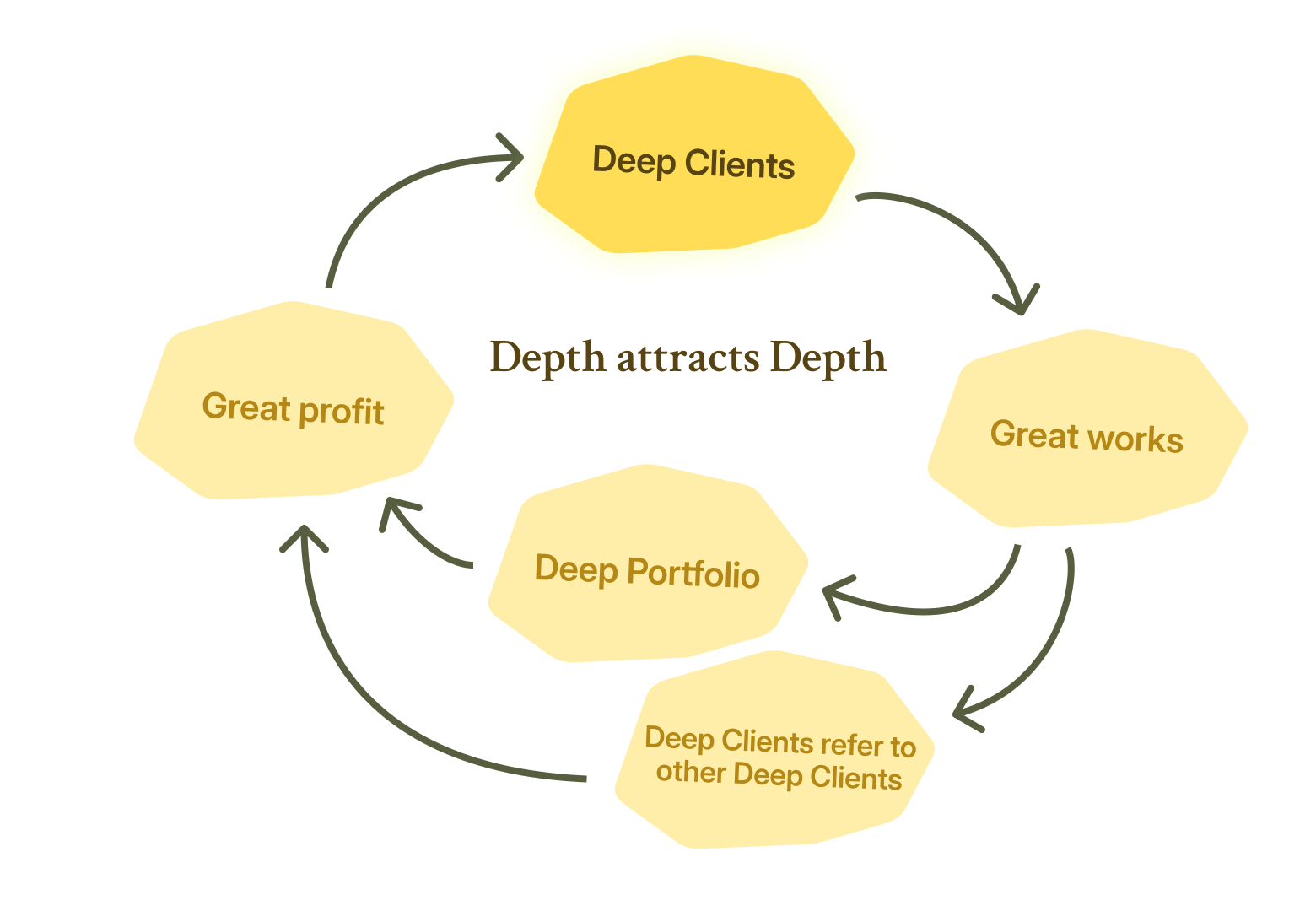
Because the work is exceptional, they tell others. Not random others. People like them. People who will also recognize themselves in your message.
Those people arrive the same way. Pre-aligned. Ready to be led.
This is the cycle. Recognition creates trust. Trust allows great work. Great work creates advocacy. Advocacy brings more recognition.
You stop chasing. The system sustains itself.
The Problem You’re Actually Facing
You already believe in depth over volume. You’re tired of shallow projects and price-sensitive buyers. You want fewer clients who value what you do.
The philosophy changed. But your machinery didn’t.
Your website still speaks to everyone. Your content still chases engagement. Your sales process still tries to convince.
Every piece of your system was designed for volume. And volume machinery can only produce volume results.
The system contradicts the philosophy. And the system always wins.
Specificity Is Generosity
Here’s what most people miss: being specific about who you serve isn’t selfish. It’s the most generous thing you can do.
When you’re vague, no one feels recognized. Everyone can sort of see themselves in your offering. But no one thinks: this person understands my exact situation.
When you’re specific, the right people feel immediately understood. You become the answer they’ve been searching for.
And the wrong people? You save them time. They can tell quickly that you’re not what they need. They find another solution. No one wastes energy on a mismatch.
Specificity lets you give your deepest value to the people who need it most. That’s not exclusion. That’s generosity.
A lighthouse doesn’t try to be visible to every ship on the ocean. It shines a consistent signal for those seeking a particular harbor. Ships looking for a different destination ignore it. Ships looking for that harbor navigate toward it. Your specificity is the signal. Your consistency is the light.
The lighthouse doesn’t chase ships.
The Foundation: Radical Clarity
You cannot resonate if you are fuzzy.
Most founders are terrified of narrowing down. They think specificity means losing opportunities. So they stay broad.
“I help businesses grow.” “I do digital strategy.”
Safe. Forgettable. Invisible.
When you try to speak to everyone, you speak to no one. If you are everything for everyone, you become the average of everything. Interchangeable. Comparable. Competing on price.
You must be willing to be ignored by the many so you can be recognized by the few. This is the fear that keeps most people vague. But vagueness has its own cost. It attracts people who don’t understand your value. It fills your calendar with shallow work that drains you.
Clarity isn’t exclusion. It’s the deepest form of service. You’re saying: if this is you, I can help you more than anyone else can. If this isn’t you, I’m saving you time to find what you actually need.
How to Build Specificity
Specificity has infinite layers, but I’ll introduce the 3 that I applied for my Fewer, Deeper Clients positioning. Each layer sharpens your signal and strengthens resonance.
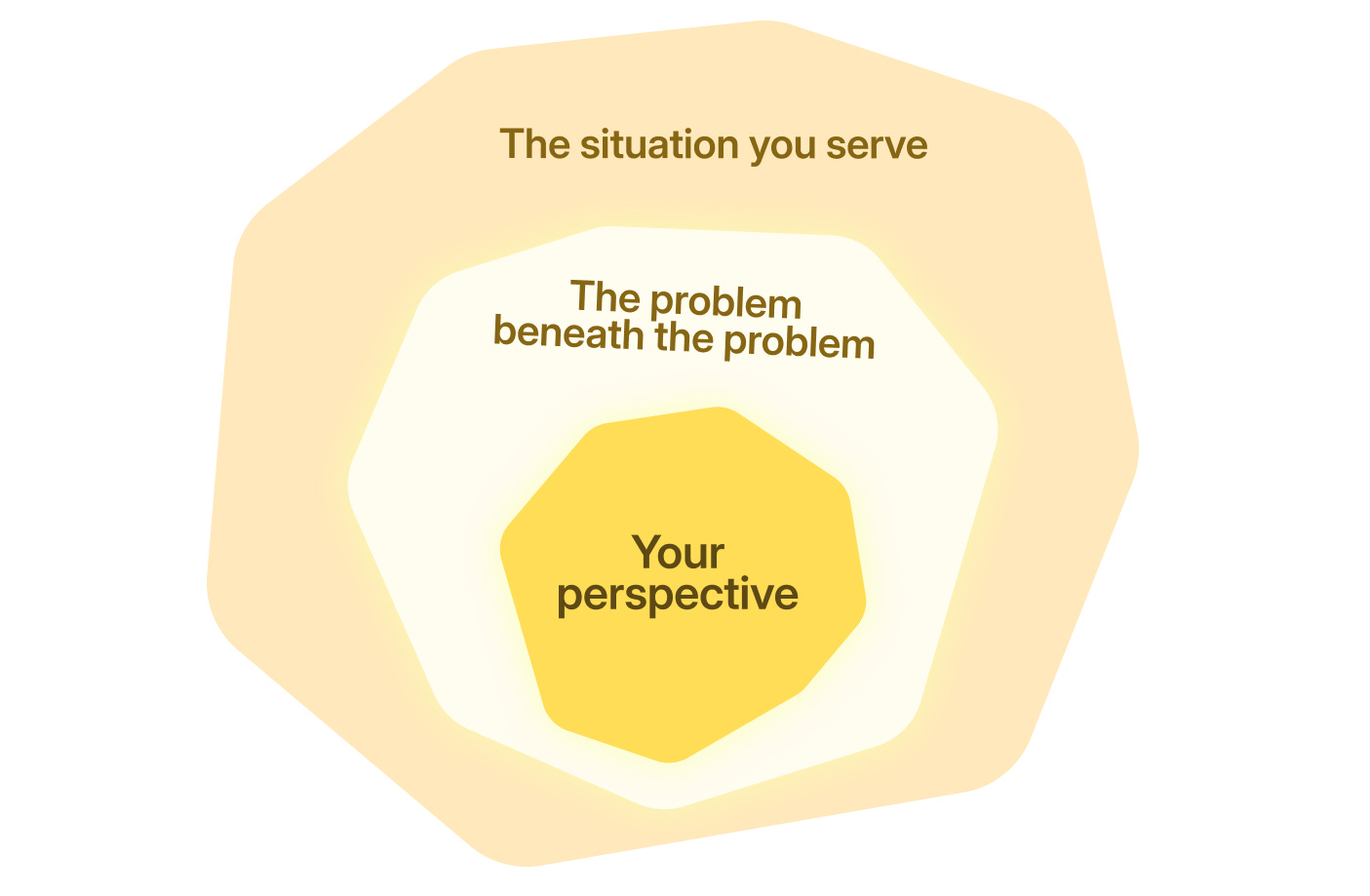
Layer one: The situation you serve.
Not an industry. Not a demographic. A specific situation your clients find themselves in.
Generic: “I build website for companies.”
Specific: “I work with founders who’ve grown through getting clients with desperation, but now need a system that attracts the right clients without them personally pushing every conversation.”
The situation includes where they are, what they’ve tried, what’s not working, and what they’re ready for. When someone reads your description and thinks “that’s exactly where I am,” you’ve nailed the situation.
Layer two: The problem beneath the problem.
Most clients describe surface problems. “I need a new website.” “I need better marketing.” “I need more leads.”
Specificity means naming what’s underneath.
Surface: “I need more clients.”
Beneath: “I’m attracting the wrong clients. Price-sensitive, demanding, not valuing my expertise. More of the same won’t help. I need different clients.”
When you name the deeper problem, something shifts. The client feels seen. They think: this person understands what I haven’t been able to articulate.
Layer three: Your perspective on the solution.
This is where you become irreplaceable. Not just what you do, but how you see the problem differently.
Generic: “We build marketing systems.”
With perspective: “We build marketing systems designed for fit, not volume. Most marketing optimizes for more leads. We optimize for right leads. The goal isn’t a bigger funnel. It’s a better filter.”
Your perspective is your point of view on why conventional approaches fail and what actually works. It comes from your experience, your thinking, your way of seeing.
When all three layers align, specificity becomes magnetic. The right people recognize the situation, feel understood in the deeper problem, and trust your perspective on the solution.
The Difference in Practice
Generic positioning:
“We help B2B companies with marketing.”
This could be anyone. It describes a category, not a perspective. It invites comparison with every other B2B marketing provider.
Specific positioning:
“We build marketing systems for founders who are done with volume and ready for fewer, deeper clients—the ones who pay for your expertise, trust your leadership, and advocate for your work.”
This is different. You’re not describing a service. You’re naming a situation. A frustration. A desire.
The right clients don’t need persuading. They need confirming. They already believe what you believe. They just needed to find someone who believes it too. They convinced themselves the moment they recognized their own thinking in yours.
That’s recognition. That’s resonance.
The Decision Ahead
You don’t have to convince anyone.
You have to be specific enough that the right people recognize themselves. Clear enough that your signal cuts through the noise. Consistent enough that they can find you.
Specificity creates resonance. Resonance replaces convincing. And when you stop convincing, everything changes.
The clients who arrive through resonance trust you before you’ve proven anything. They let you lead. They become advocates.

Not because you convinced them. Because they recognized themselves in what you already were. That’s the shift. From convincing to resonating.
Convincing is an act of will. Resonance is an act of truth. When you stop performing who you think they want, and start expressing who you actually are, something shifts. The wrong people leave. But they were always going to leave. And the right people finally see you clearly. They were waiting for you to stop hiding.
It might not be the path for everyone. But if it’s the path for you, you already know.
You have the courage to resonate.
—From Hieu
