


Next
Your website speaks to everyone. There's a quieter, deeper way
You're already exhausted from trying to market yourself in ways that feel fundamentally wrong. I know because I spent years forcing myself through tactics that left me drained to attract non-sense clients and disconnected from the work I actually loved.
February 6, 2026
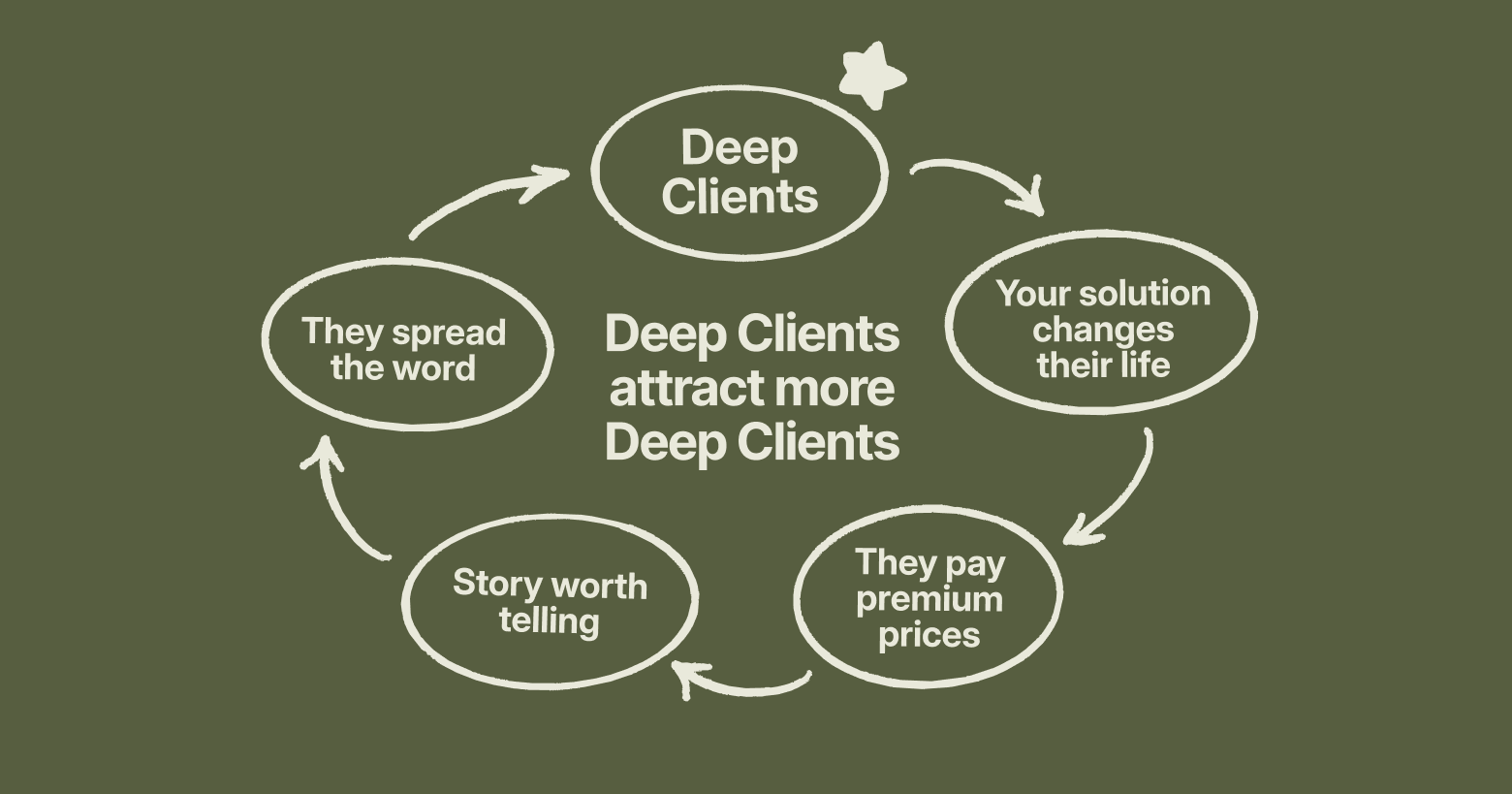
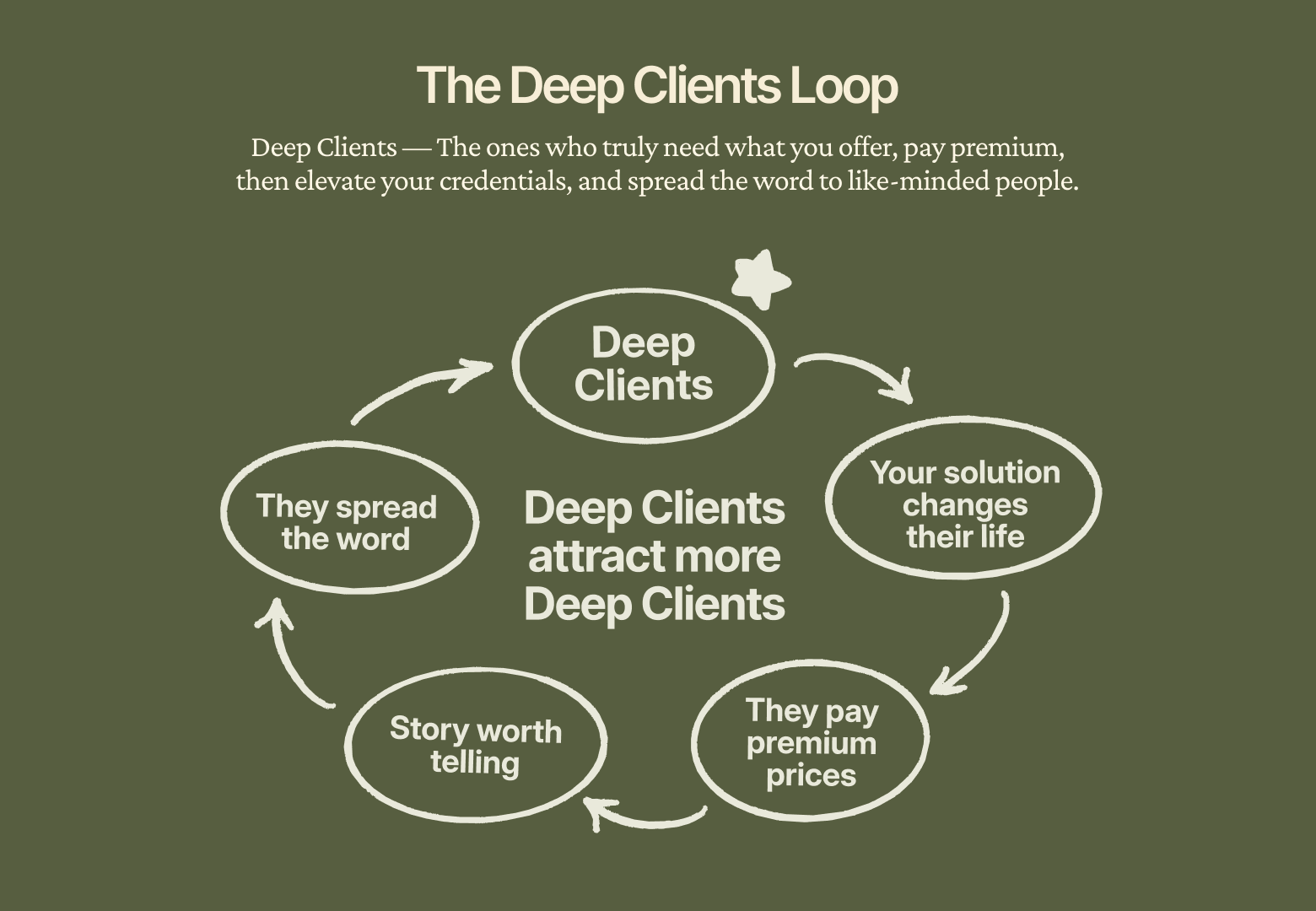
Welcome to The Deep Clients. We break down the brands that grow by being impossible to ignore. We analyze the principles they use to resonate with Deep Clients—the people who don’t just buy from them, but invest in the brand and spread the word to like-minded people.
And you can build yours.
----
You’re exhausted from marketing yourself in ways that feel fundamentally wrong.
I know because I spent years doing the same thing. Forcing myself through tactics that drained me to attract clients who didn’t value what I actually do.
The people who’ve worked with you love what you offer. But the ones finding you online? They ask about your prices. They compare you to five other options. They treat your expertise like a commodity they can negotiate down.
I remember the inquiry that finally broke something in me. Someone asked for a $500 website and promised that if I did it well, they’d send me “lots of projects like that.”
I spent years questioning my expertise. Redesigning my website. Writing case studies. Posting consistently. Each time, I got more traffic, more inquiries, more calls. But the people on those calls were always the same. Looking for a service provider. Not someone who could change how they think.

The turning point wasn’t a new tactic. It was a conversation with a client who came through a referral. She told me: “I didn’t hire you because of your website. I hired you because you can say the pattern in this industry that rarely people can realize.”
That’s when I stopped asking “how do I get more people to find me?” and started asking a different question: “Why do referral clients already get it, while the ones who find me online don’t?”
The answer was simple and painful.
Referral clients arrive with a story. Someone they trust has already told them what makes you different. Your website tells no story at all. It lists services. It shows logos. It says what every other consultant’s website says.
It attracts people looking for a provider. Not people looking for you.
The way most of us were taught to market online was never designed to attract the right people. It was designed to attract the most people.
That’s the shift at the heart of what I call the Deep Clients approach. And in this article, I’ll show you the three changes that make the biggest difference, and what becomes possible when you design for resonance instead of reach.
The three shifts that change everything
Looking back at the work I’ve done with service businesses over the years, I can see that the ones who attract deep clients, the kind who truly need what they offer, pay premium, and spread the word, all made three shifts. Each one built naturally on the last.
Shift 1: From competing with noise to hearing your own voice
Most website advice starts with the same formula. Write a strong headline. List your services. Add testimonials. Include a clear call to action. Optimize for conversions.
There’s nothing wrong with any of that on its own. But when everyone just follows the same “winning” formula, every website in your space starts sounding the same. Same structure, same language, same promises. You end up competing in a sea of noise where the loudest voice wins, not the deepest one.
You just copied the skin, not the heart.
The heart, the mindset that stands behind all of those decisions, is what counts.
The first shift is choosing to step out of that hustle copying entirely.
Instead of asking “what do winning websites look like?”, you start asking:
- “who do I want to attract?”
- “what do I actually believe about the problem I’m solving that nobody else is saying?”
- “what changes do I want to make for my clients?”
Instead of trying to sound professional and polished in the way everyone else sounds, you start sounding like yourself.
This is harder than it sounds. Most of us have spent years absorbing what a “good” website is supposed to look like. We were too focused on tactical things to make us seem like someone else, or a little bit better than our competitors.
This time, letting go of those “template thinking” takes courage to develop your HEART. When you can hear your authentic voice and develop a presence that completely reflects that, something changes. Your website stops blending in. It starts resonating like yourself.
Not with everyone. With only your people.
Shift 2: From visibility to discoverability
There’s an important difference between being visible and being discoverable.
Visibility requires constant effort. You have to keep showing up, keep posting, keep pushing your website in front of new eyes. The moment you stop, the traffic stops with it.
Discoverability works differently. It means your website is built so that when the right person is searching for exactly what you offer, they find you. Not because you were shouting the loudest, but because you named things clearly, spoke to a specific experience, and built something that naturally surfaces when someone needs it.
I’ve seen this happen over and over. A consultant writes one honest page about what they actually believe, and it quietly attracts the right people for years. A coach names a specific problem their clients face, in the language those clients actually use, and suddenly the inquiries shift. The people reaching out aren’t price-shopping anymore. They’re saying “I felt like you were describing my exact situation.”
This isn’t about SEO tricks or keyword stuffing. It’s about clarity. When your website speaks directly to a specific kind of person about a specific kind of problem, both humans and search engines know who it’s for. The right people find it. The wrong people scroll past. Both outcomes are exactly what you want.
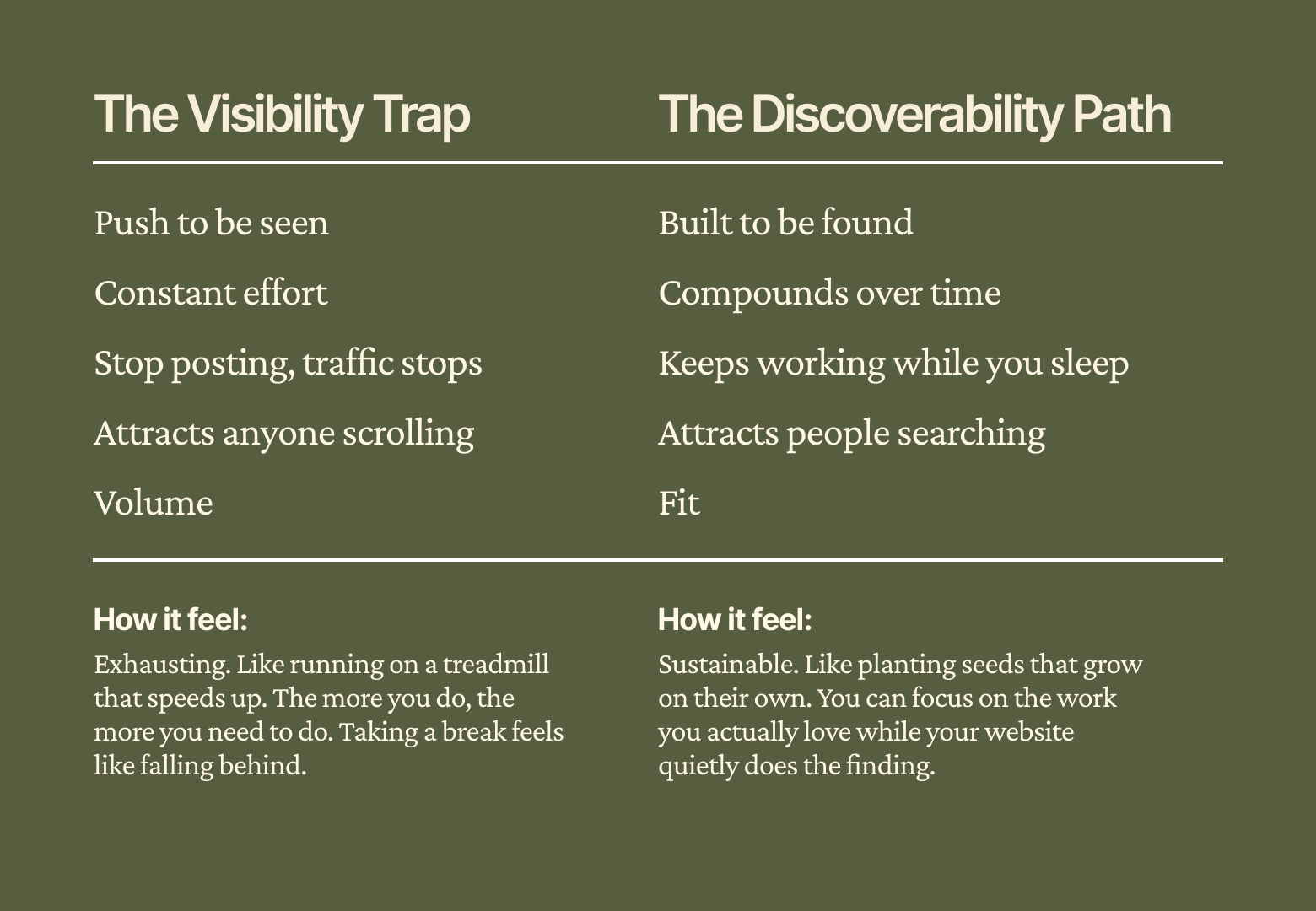
The question worth sitting with: is your website designed to be found by the people who need you most? Or is it designed to impress everyone who happens to visit?
"Be found by the right people, not seen by everyone."
Shift 3: From the content hustle to a Resonance Ecosystem
The conventional approach to online marketing is relentless. Post consistently. Be on every platform. Create content daily. Run ads. Build funnels. Feed the algorithm or fall behind.
It works, for volume. But it’s exhausting. And for someone whose real gift is depth, it’s a trap. You spend all your energy creating content to stay visible instead of doing the deep work your clients actually hired you for.
The third shift is moving from this cycle to a Resonance Ecosystem. Your website sits at the centre, designed to speak clearly to the right people. Your content, whether it’s a few blog posts, a podcast, a newsletter, whatever feels natural to you, extends that resonance so more of the right people can find their way to you. And your process, from the first visit to the first conversation, filters for fit rather than chasing volume.
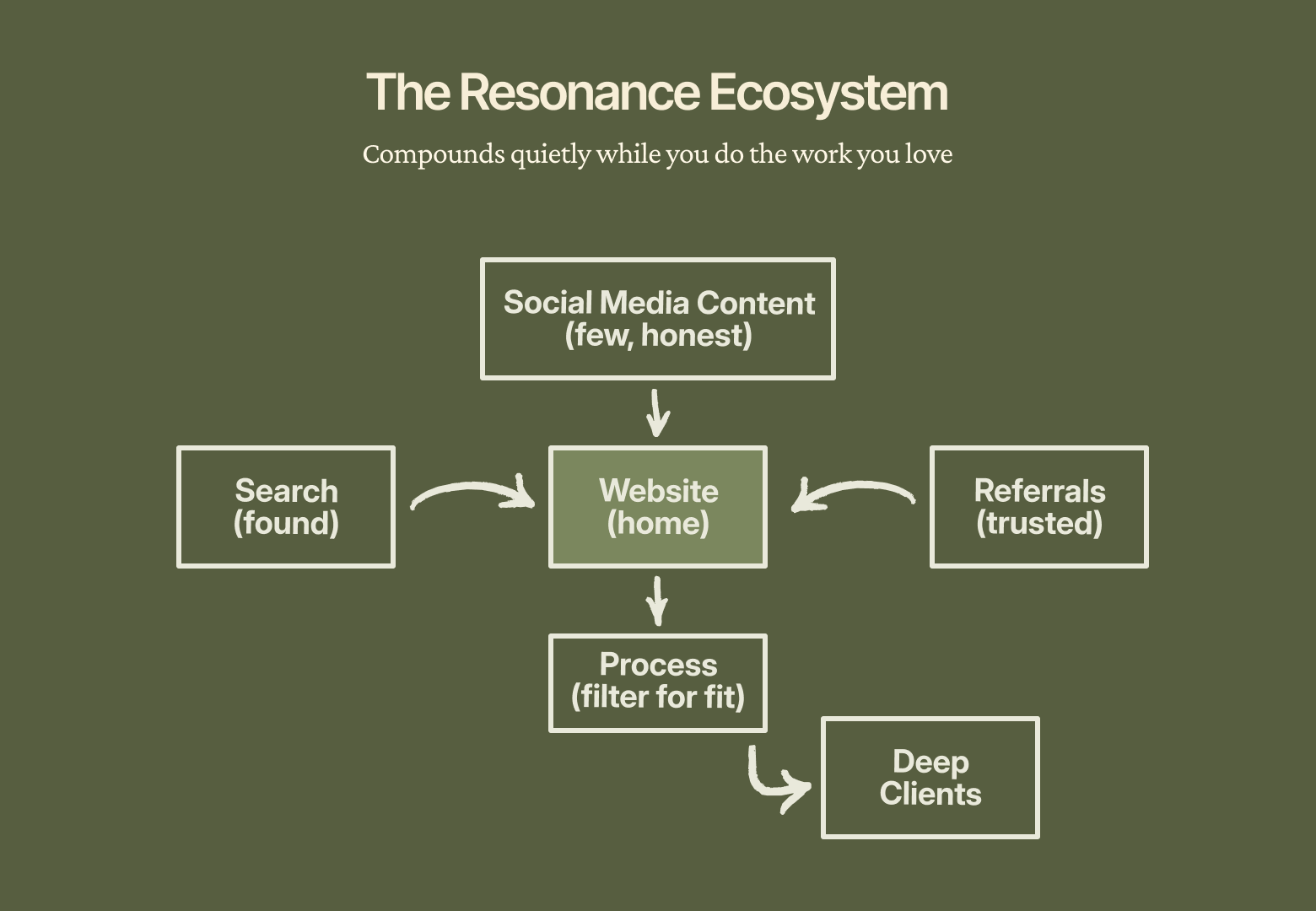
This ecosystem doesn’t require constant feeding. It requires clarity. Once it’s built around a genuine point of view and a specific kind of person, it keeps working. People find your site through a search. They read something that resonates. They come back. They reach out. Sometimes months later. Sometimes years.
The beauty is that it honors your energy. You’re not running on a hamster wheel of content creation. You’re building something that compounds quietly in the background while you focus on the work you actually love.
What this means for your website
These three shifts aren’t abstract ideas. They have very practical implications for how your website is designed.
Your homepage isn’t for everyone. It’s for the specific kind of person you most want to work with. It should feel like relief when the right person lands on it. “Finally, someone who gets it.” And it should feel like friction when the wrong person visits. That friction is a feature, not a flaw.
Your messaging leads with what you believe, not what you deliver. Services pages that list deliverables attract people who compare deliverables. Pages that express a genuine point of view attract people who share that point of view. The difference between “I offer brand strategy” and “I believe most businesses are attracting the wrong clients and I help fix that” is the difference between being compared and being chosen.
Your design signals who you’re for. Every visual choice, the typography, the colors, the pacing of the page, the amount of breathing room, sends a message about who this is for. A website designed for depth feels different from a website designed for volume. The right people notice, even if they can’t articulate why.
Your process filters before it converts. Instead of making it as easy as possible for anyone to get in touch, the strongest websites make the right people feel invited and the wrong people feel like this isn’t for them. Your pricing is visible. Your point of view is clear. Your intake process asks the kind of questions that only someone who’s serious would want to answer.
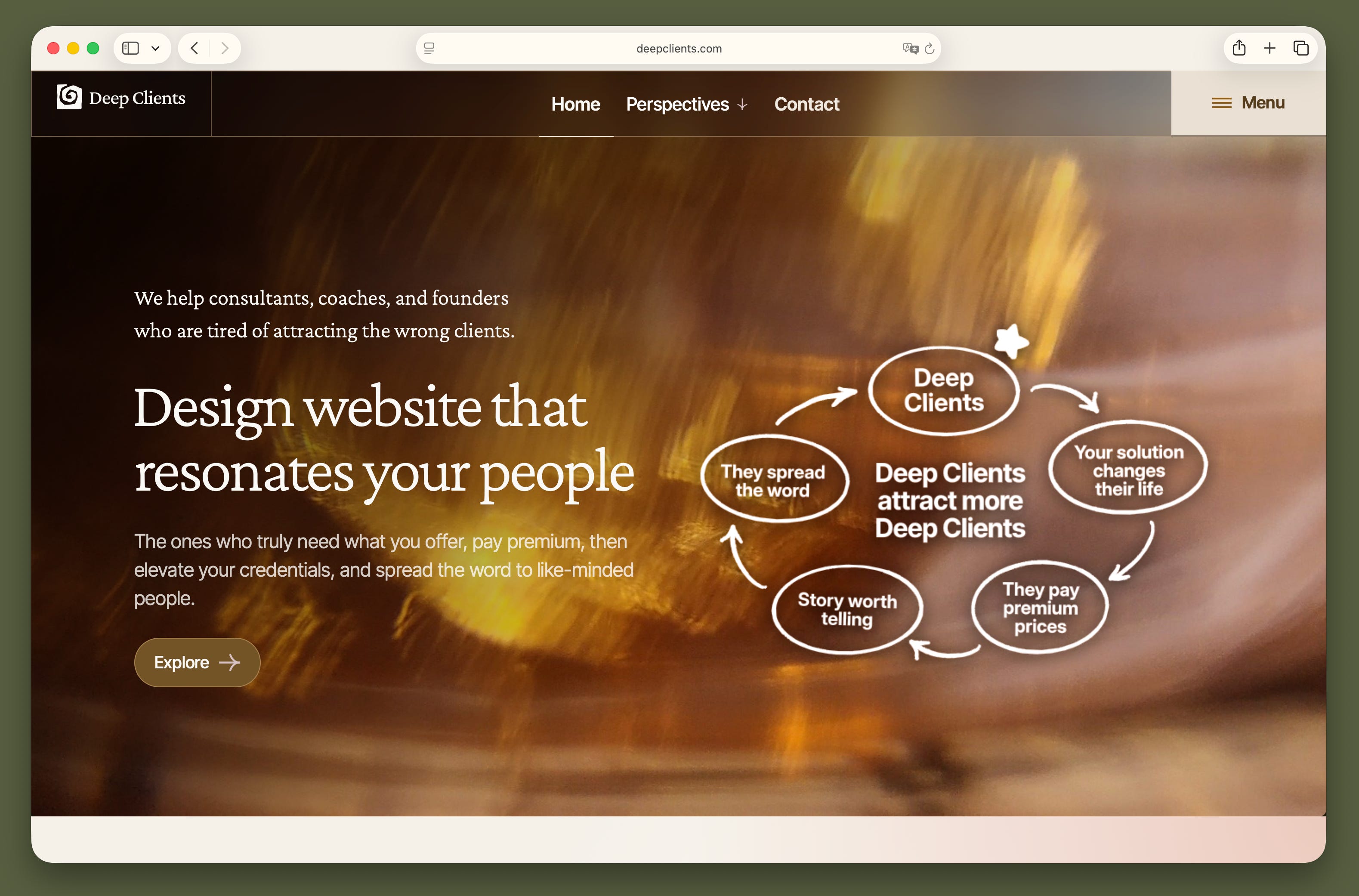
When all of this works together, something changes. The inquiries are different. The conversations start in a different place. People show up already understanding what you’re about. Already trusting that this is the right fit.
That’s the Deep Clients loop in action. The right people find you. Your work creates real change in their lives. That change is visible. They tell others. And those others, because they come from the same kind of person, arrive pre-qualified.
One deep client becomes a permanent asset. Their experience is your best case study. Their network is your pipeline. Their story is your most effective marketing.
Who this is for (and who it’s not)
This approach is for you if you’re a consultant, coach, or founder who:
Already does deep, transformative work but your website doesn’t reflect it. You’re getting inquiries, but they’re the wrong kind. Price-sensitive, comparing you to five alternatives, not really understanding what makes you different. (Note that I can’t turn an ordinary service provider into a ding-dong high-ticket expert.)
You’ve outgrown the template. You started with a DIY website or hired someone to build something functional, and it worked for a while. But now it’s holding you back. It’s attracting a version of your business you’ve already moved past.
You’re ready to hear honest feedback. You sense something is off but you can’t quite pinpoint it. You want someone who will look at what you’ve built and tell you where it’s working and where it’s quietly pushing away the people you most want to reach.
This is not for you if you want more traffic, regardless of quality. If your goal is volume, more leads, more clicks, more conversions, there are plenty of people who do that well. That’s a different game entirely. The one I’m offering to help you with is attracting fewer, better people who pay premium and become long-term assets for your business.
Where to start
If this resonates, I’d love to have a conversation.
Not a sales pitch. A real conversation about your business, your clients, and where your website might be quietly attracting the wrong people or pushing away the right ones.
I’ll share what I see honestly and barely. You’ll walk away with clarity about what’s working and what isn’t attracting fewer, deeper clients, whether or not we end up working together.
You don’t need to be louder. You don’t need to post more or run more ads or build a more complicated funnel.
You need a website that sounds like you. That stands for something specific. That quietly attracts the people who need exactly what you offer and lets everyone else find what they’re actually looking for.
The right people are out there. They’re searching for someone who sees things the way you do.
Your website just needs to help them find you.
— From Hieu Vu

How Fujifilm built a brand that markets itself through believers.
The clients who become evangelists aren't the ones who agree with the consensus. They're the ones who've been waiting for someone to validate their different way of seeing.


Aesop: The brand that refuses to convince you
When a brand stops trying to convince people and starts trusting them to recognize what they're experience

What reMarkable can teach you about building a deep brand (that sells itself)
How you can build a brand your dream clients market themselves toward.

Why the best clients never need convincing
Convincing creates shallow clients. Not because they’re bad people. Because the relationship was built on push-pull and persuasion, not resonance.